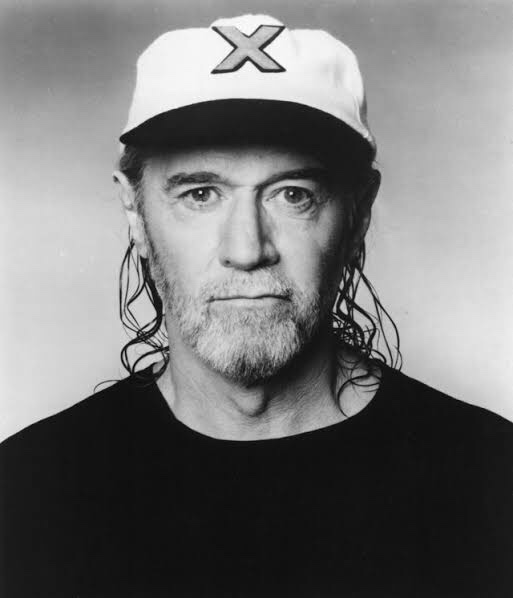
I often think of the standup set by comedic genius George Carlin (pictured above in a photo from the internet, I do not own it!) entitled, “Saving the Planet.” In it he hilariously notes the arrogance of “attempts by humans to control nature” and the mentality that we could, “save the planet,” with the line, “the planet is fine, the people are f*cked.” (Yes, there will be swearing on this blog. I’m not here to police people’s language, myself included.)
Why, according to Carlin, are we f*cked? Because we haven’t yet learned to take care of ourselves: “We haven’t learned how to care of one another and we’re gonna save the f*cking planet?!” Still, he tells how so many people are worried about it, trying to fix something outside of themselves, trying to save something–the air, the water, the soil, the food we eat from things like additives, insecticides, pesticides, carcinogens, to name a few. Meanwhile, Carlin says, the planet, when it’s ready, will “shake us off like a bad case of fleas” before healing itself.
What a flip in thinking—the environmental rhetoric then in 1992, which persists now in 2021 was, “save the planet!” Instead, George Carlin is encouraging us to try to save ourselves. He is saying that if we do not make personal behavior changes, our existence at its current consumptive rate will make Earth uninhabitable for humans.
This may have a similar end result to action aspired toward from“save the planet,” however, it comes from a different perspective. The focus is not on fixing all of the “problems” that are occurring on the planet which is overwhelming and waaaaay more than your average person can handle, frankly. The focus is on individual behaviors and adapting them to be more in alignment with the needs of the planet.
When I first got into education, I was totally the “save the world” type. In fact, I was the type to say to kids, “it’s your job to save the world, to leave it better than you found it!” I would say such things with a smile after taking kids on hikes through the woods, then follow up with an overly enthusiastic, “okay?!” Usually there were a few or half-hearted responses, yet I would push further in that “well meaning” way, saying, “I can’t hear you!” until they said, “Yes, Ranger Madi!”
I still cringe at these memories. I still feel silly for attempting to manipulate kids, even for what I considered at the time a “good cause.” I have learned since then that this technique does not help anyone in the situation actually achieve their goals.
Instead of inspiring the kids to make change, my words left them feeling bored and tired of being told what to do by almost everyone in their lives (even the “fun park ranger” who also thought it was cool to smell dirt). I lost their trust, received a false sense of a pat on the back, and got a very real sense of rejection from their lack of zeal over something I clearly cared so much about. This strategy of getting needs met through orders and obedience doesn’t feel good anymore. My focus has shifted from outcomes of interactions to building equitable relationships and feeling good/ease full communicating with people.
I recognize that I didn’t know any other way back in the days of Ranger Madi. I recognize that I had never learned any other way to relate with people aside from variations on control. It was probably because most people around me when I was a kid didn’t know of any other way themselves—I mean, what aspect of modern capitalist culture really prioritizes listening and care anyway? This is all to say that I know the conversations I’m going to share on this blog, all of the interactions described here, weren’t easy for me.
It has been work to get to a place of feeling comfortable relating with people, with kids, in a consensual, respectful way. And I’m still learning. This blog is a form of reflecting on a lot of practice (and failure) I’ve had over the years. Practice at shifting my mindset away from “saving the planet” and more toward, “caring for myself and the planet according to my values.”
And, what if, in this metaphor, we exchange the planet for kids? “The kids are fine, the adults…” What if the “sicknesses” adults try to fix in kids are actually traceable back to adults? The adults might be ones in the kids’ immediate lives or those who formulate society behind the scenes, both trying to get the kids into some “ideal outcome.”
The thought that adults can set the foundation for upsets in kids is, I’m sure for at least some of you, a wild notion. I imagine it’s especially wild for people who know kids with energy enough to power football stadiums or kids who experience frequent sleepless nights in infancy. Sure, kids go through their own hiccups, illnesses, and mood swings, just like adults do and just like Earth when it has storms and tremors. These are temporary experiences, though. What amplifies them is highly intrusive, impactful human activity.
For those of you reading this who know children and are worried that you may have, “f*cked them up,” Carlin’s potential reason for the planet allowing such detritus of human manipulation may give you some relief.
The Earth doesn’t share our prejudice towards plastic. Plastic came out of the Earth! The Earth probably sees plastic as just another one of its children. Could be the only reason the Earth allowed us to be spawned from it in the first place: it wanted plastic for itself, didn’t know how to make it, needed us. Could be the answer to our age-old philosophical question: “Why are we here?” PLASTIC!!!
This is a drastic line of imagination for tree huggers like me out there, but let’s suspend disbelief for a moment to play with the metaphor. Maybe all those “f*ck ups” that are running through your mind, worried parent, educator, auntie, etc., are the answer to the question, “why me? why am I in that kid’s life?”
Maybe you’re there so the kid can take what you saw as harm and make something new of it. And maybe you can both accept the hurt, make your amends to each other, and experience less shame or need to change or challenge things in one another’s lives. Maybe there’s time to do what you can in order to move into a more easeful and fulfilling relationship with this kid, taking care of yourselves and celebrating the love you have for each other along the way.
So what do we do to get back to harmony with the natural cycles of development for the planet and for kids? How do we live in a more collaborative way with these two powerful forces of nature? Carlin’s take? Accepting that “we’re part of a greater wisdom that we won’t ever understand, a higher order… [that] doesn’t punish, it doesn’t reward, it doesn’t judge at all. It just is” and allowing ourselves to just be, for a little while.
I hope this blog can give some examples of what it looks like to relate to the kids in your life without the necessity for punishment, reward, judgement. I hope it can show how people respect kids’ inner configurations, needs, and desires. I’ll give examples of how I’ve attempted to do that in spaces that try to approach learning differently than the public education model—self-directed education learning communities, homeschool/unschool coops, anarchist meetup groups populated mostly by young people.
I hope to show you how it could look, get you dreaming of your own possibilities, instead of telling you how you “should do it.” And I ask that you be open to listen.
 Madi Learns