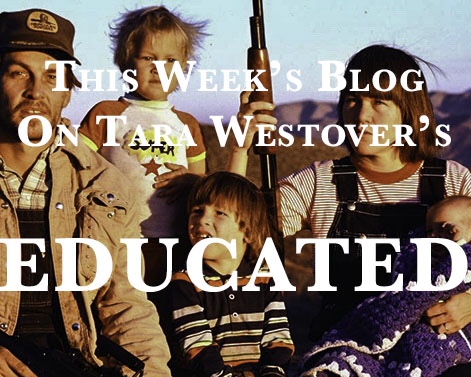
After receiving many recommendations to do so, on the basis that I am a person in education, I recently read “Educated” by Tara Westover. I was aware of the book’s connection to unschooling and its homesteader, off-grid focus. People had given some insights into the drastically abnormal learning environment in which Westover grew up; they mentioned a wild scheme of her father or two as a kind of warning, as if to say, “it gets pretty absurd.”
What they did not prepare me for, what, I imagine, no one adequately could have prepared me for, was the abuse Westover incurs throughout the course of the memoir. In fact, in the handful of recommendations I received, not one person mentioned anything remote about domestic abuse or violence, of which there are numerous occurrences in the text. I wonder about this, why it was not mentioned in peoples’ pitches of the text to me—is it because I’m an education person, so that angle might attract me most to the text? Are people uncomfortable talking about abuse? Are they uncomfortable talking about it to me?
I realized very early on in reading “Educated” that the arc of Tara’s education was not going to be only how to reckon her unconventional learning environment with that of the world beyond her childhood mountain home. I saw in her brother and father’s behavior toward her that her self education must also involve some evolving awareness around gender equity, self worth, and, frankly, healing and therapy. Some might argue this arc is more central to the story than that of “learning,” though I’d say they’re both learning, just different subjects, but very much related to one another.
One of the core beliefs of self-directed education is that people learn more of the context in which they are than of the content being presented to them. Another is that learning is natural and is happening all the time. Apply these two tenants to Westover’s journey in the book and what do we find her learning? How to conform, how to survive, how to numb and ignore pain, how to fight for access to schooling, how to connect with people, how to see herself, how to see others as they are, how to treat herself, how to set boundaries, and a good deal more. Her learning isn’t just in History, Music, or Scholarly academia, it is in so much of what it means to be human in an environment that tries to coerce subservience out of her.
The two arcs feed one another throughout the text, though the images that stay with me from it are of her abuse. I cannot shake the knowledge that this happened in a family that self identifies as “homeschooling,” and the awareness that such atrocities can be put on children in those environments. It laid bare a truth to me that I hadn’t seen so clearly before: conventional schools can be harmful, but homeschooling can be harmful, too.
While reading the text, I wanted an outsider to intervene and stop the violence against the women of this family. I had met someone who works as a social worker just before reading this book and asked her to tell me more about what she does. I thought of her observational approaches, her advocacy for kids, and her kind smile. Could she have been helpful in getting Tara’s older brother away to counseling and supporting Tara to live and learn in peace? But in the book, no one came.
In reality someone’s intervention might have been helpful, but it could also have been more incimial for the family—I imagine not every social worker moves from such a place of genuine care, awareness, and concern. If social workers were present, Tara’s father might have spiraled even further into fear of the government, an official might have overlooked the real problems at hand and the abuse might have continued or worsened, and/or the family might have become more stressed or burdened by the threat of policing from government officials. And if an official had separated Tara from her family, would she have been better off in foster care? An orphanage? Would Westover have become who she was? Touched so many people through her writing? I’m not sure. I’m left with a lot more questions than answers about homeschooling, but I am grateful to Tara and “Educated” for having complicated my views of it.
MORE FROM TARA WESTOVER: Read “Educated,” and tell me what you think in the comments of this post!
 Madi Learns