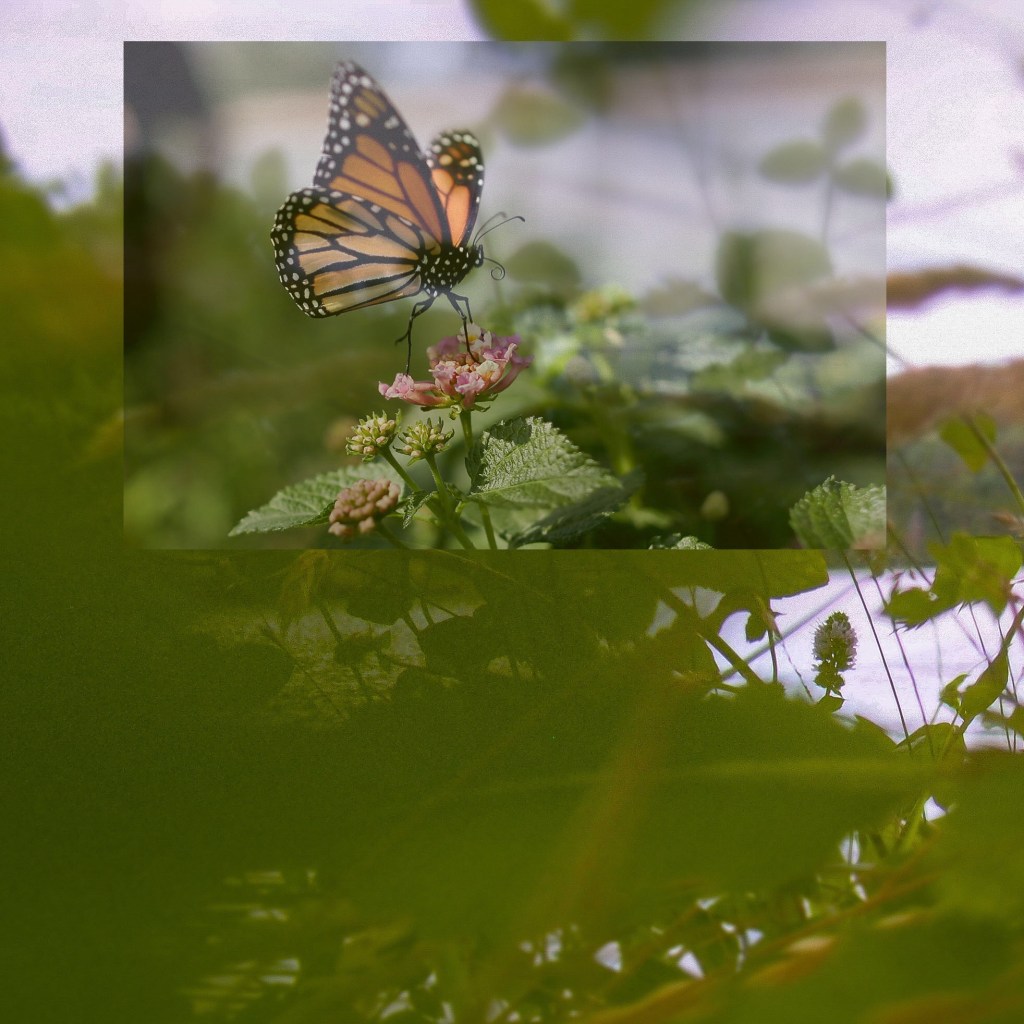
No words I’ve read have felt more true to my adult experience of creative writing than those of Ann Patchett in The Getaway Car. She describes her idea for a novel as being a shimmery, unpredictable, indescribable, captivating beauty that flies across her mind, much like a butterfly. And once she is no longer able to delay it, she plucks the butterfly from her head and presses it to paper, killing it, and that pinned specimen is the book she writes. Birth for death, death for creation.
I love this image because I know that, these days, so much is lost in translation of ideas from my brain to the page. And that trying regardless will sharpen my pen to exact precision in parsing the idea to language. For me it is much easier to leave writing ideas in my imagination, catching the light of other worlds and sparkling perfectly. But when I want to share these ideas with other people, like right now as I write this, I must use different skills than imagining, I must discern, I must delineate, I must detail. And sometimes when I do this, the process becomes quite lengthy and difficult.
I have not always been this kind of writer, though. I wrote illustrated poems when I was six years old and never blinked an eye to even look back at what I’d written. Just got it out and kept moving on, as if the butterfly soared to the page then landed back in my brain. I wrote so many poems I don’t even remember a single one. I had the same type of process in High school, though the poems were generally longer and more angsty. This process usually yields short term contentment and then boredom that forces my hand forward. However, it does not yield long bodies of work that require persistence and determination.
I believe there is value in both the more imaginative, playful, butterflying end and the infinitesimal work of entomological preservation into antiquity. Even today I do not bring every idea to long form writing projects, or to the page at all, because I believe there are some writing dreams that enhance my life through their sheer wonder and awe. As if it’s more fun to say, “pretend that…” than to make it happen. But I think the pressure to “make something” of every idea is one that weighs heavy when put onto others.
It can happen in SDE spaces where adults want to help kids bring their ideas “to fruition,” pushing them beyond exploration and imagination. If a young person in a space were to come to me and ask, “can you help me make a rollercoaster,” I’d say sure and ask questions, because they are inviting me to kill their butterfly with them and I want to help them get the dream as close to reality as possible. But if a young person said, “imagine there was a roller coaster that blasted off into outer space!” I wouldn’t necessarily say, “let’s make it!”
Why not? Two reasons: the first is that it was their idea and if I bring myself in I might be co-opting it. Of course, I can ask, “would you be interested in making it together?” And see what they say. But the second reason that compels me not to is this…
Sometimes imagination is more powerful a teacher than the experiential learning that can come from extracting ideas into the 3D.
The chance to dream bigger, imagine farther than possibility, is the chance to practice the skills of hope and creative thinking and aren’t these just as valuable for young people today as those that come from making things?
BK APPLE FILM: here’s an example of a way cool project some young people at BK Apple Academy made in collaboration with my friend, Alex Khost. Check it out HERE and donate to support BK Apple Academy HERE.
 Madi Learns