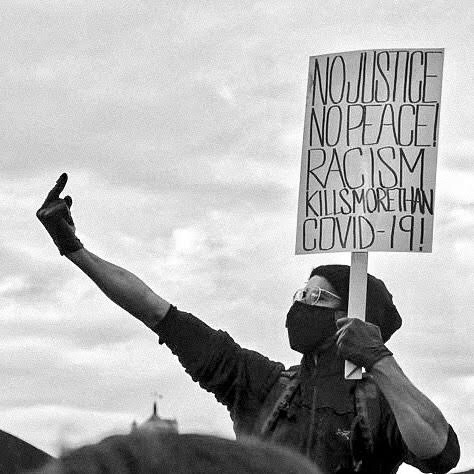
This photo was taken at the 2020 BLM protests in NYC by my dear friend, Rev Alison Schuettinger of Alison Lee Photography. Find more of her work at her Instagram, @alisonleebk
Preface: I’m open to and encourage any and all feedback on this post and my approach to it. Please and thank you!
I’m listening to a podcast mini-series on the history of a public school in New York City. The podcast is titled, “Nice White Parents.” I find the stories it tells relevant to SDE and, really, all communities where there are white folks present. It details the subtleties of white supremacy in power dynamics of “seemingly equal groups” such as parents at a public school. It shows who really sustains the segregation of the NYC public schools (and I’ll tell you, it ain’t just the DOE), and how white folks can come into communities of color and push BIPOC to the edges–sound like any neighborhoods you know of? Throughout the series these “Nice White Parents” build on their already institutionalized privilege of whiteness by using a combination of monetary bribes and threats to leave as their cornerstones for getting what they want for their children, which is often the label of giftedness and a separation from young folks who are BIPOC.
It makes me sick. But I look at it and I learn from it so that I, as a middle class white woman in the US, don’t repeat it myself.
I do not believe that SDE is void of white privilege and racism by any means. In fact, I think it is full of it in ways that are both similar to the public school issues but also uniquely different. Here are a few examples of issues around race and privilege that either I have encountered or that other folks in the SDE movement have encountered and shared.
- Young people who are BIPOC being picked on, blamed, or bullied by other young people for no reason and more frequently than the young folks who are white
- BIPOC families and facilitators not feeling represented in the books, posters, dolls, or media presented in the space or feeling alone among a predominantly white staff or among a community made up of predominantly white families
- White parents complaining that a person of color in the community is either a bully or not trustworthy without any extenuating circumstances to validate such a claim
- Parents and facilitators (the SDE equivalent to teachers) who are BIPOC (Black, Indigenous, People of Color) having to deal with such conflicts and do the emotional labor of educating white people on racism and white supremacy
- BIPOC parents’ concerns or concerns from their family and friends that their child will appear too free, entitled, or wild to be accepted by their community or by society at large, especially with white folks (who we know have a history of violently preventing BIPOC from being free)*
- BIPOC families being concerned for their child’s safety on field trips in public spaces (considering black and brown bodies are targets of hateful, horrendous acts in public)*
- White facilitators having to check their own biases in helping to solve these kinds of conflicts and in not favoring young folks who are white over young folks who are BIPOC
*I found these instances in Akilah Richards’ new book, titled, “Raising Free People.” This text brought me further into understanding the struggles and barriers for BIPOC families in the SDE world as well as deepened my practice of supporting freedom for youth overall. I’m so grateful to have more insight on the experience of folks of color in these spaces as well as the anti-oppressive nature of this work at large thanks to Akilah through this text.
This is just a few examples–not each one has happened in every SDE community I’ve been in. Though I can’t say they all went away after being addressed the first time either. But what I can say is this: SDE is a space that, I believe, is inextricably tied to racial justice and social justice at large. We cannot be free if we are not all free and, due to centuries of imprisonment and slavery for black and brown peoples that still exists today in our prison systems and beyond, we all have some work to make this world a more free place for BIPOC folks.
We cannot just enroll young people who are black and brown in self-directed learning centers and think the work is over because now they’re “free.” The work grows from there so that the systems of oppression that we aim to flee by leaving conventional schools do not reiterate themselves in SDE as microaggressions, plain old regular aggressions, bribery, bullying, or any other act that perpetuates supremacy of someone over someone else. The dynamic we seek is power with and we have to learn how to do that with everyone in order to really walk our talk with the young people in our lives.
RAISING FREE PEOPLE: I just finished the book, “Raising Free People” by Akilah Richards as referenced in the starred text above. In this book, Akilah shares intimate stories of life with her family, with her podcast community, with her work alongside SDE spaces, and with her own self-study in ways that show readers how we may fight against our internalized mechanisms of oppression. I listened to the Audiobook, which she reads herself, and it was a delight to hear her presentation of it, though my copy of the book itself is in the mail and en route as we speak. You can purchase a copy of the audiobook here and the physical text here.
 Madi Learns