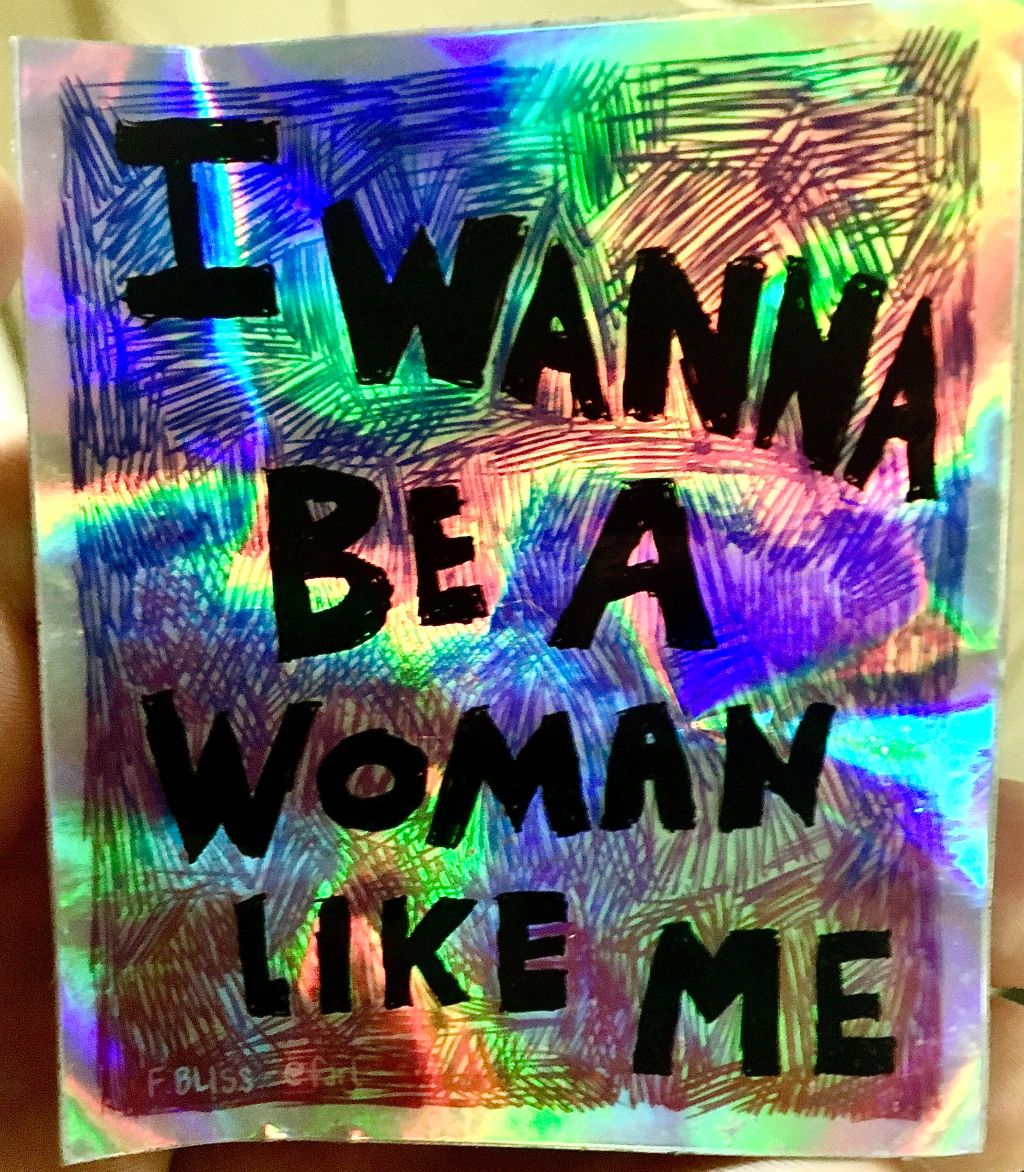
This image shows a sticker given to me and made by Farley and you can get your own here!
I tried to interview more kids about how they like their self-directed learning center recently but got very few responses. I learned firsthand how even journalistic writing can be a reflection of what the writer is interested in despite its desire for neutrality and reporting. Instead, I’ll be more forthcoming with my interests and share what I can’t stop thinking about, which is how to redesign many of the systems I interact within our capitalist, patriarchal society to be more collectivist and inspired by the feminine. In other words, I’ve been imagining femme utopia and goddess does it feels good.
So far the biggest takeaway is that my femme utopia requires deep listening. Listening with curiosity to self and others in our sensations and expressions of emotion (rather than swallowing it or using emotion as a weapon). In my idealized femme utopia, care comes before outcomes in the scheme of what’s important. Also, uterus-bearing folks are knowledgable about their bodies’ alchemical properties through being in touch with their own vessels (by shamelessly exploring them!) and through learning from learned folks who promote wellness for the physical, mental/emotional, and spiritual self.
My femme utopia respects, loves, and listens to the earth for its inherent worth, not its extractive potential. And leadership there reflects healthy communication and supports the whole and the parts of a people. We are not there and dreaming it does not make it happen–building it requires so much change I get sick thinking about it. But living out parts of it every day quells the doubt just a bit.
Today I feel grateful to find aspects of this kind of place within many of the agile learning communities I’ve been able to visit. I’m grateful to exchange heart-opening dialogues with other facilitators (SDE equivalent to teachers) about our triggers and traumas as they come into play in our experiences of free learning spaces for youth. We talk about what’s on our minds and we care about one another’s state of mental and emotional health before what each other is “doing for the community.” We are not measuring performance but are interested in the quality of our experience. In this, we recognize and adapt how we show up in these spaces–we are self-reflective, or even, self-directed.
Everything is on the table to be discussed in these spaces, so we feel no need to hide these dialogues from the young people. If one of them came up and asked, “what are you talking about?” I might say, “you remember that accident I had on my bike recently? We’re talking about that and how it’s still affecting me because I’ve been afraid to ride my bike ever since.” There are things I would not choose to expose them to for the sheer reason of heaviness–I don’t need to discuss horrible crimes and atrocities in these spaces–there are other places that can be unearthed.
Rather, these conversations help integrate parts of myself into how I show up with young people–if I feel nervous around young folks, always being fearful they may get hurt, talking with other facilitators about it makes me wonder where such fear comes from and why? Maybe even allows me to see a wound from the past, accept it, and move forward more clearly (this, as I am learning, looks a lot like trauma work).
Perhaps people are afraid of such a femme utopia because they feel afraid to see themselves…
THE WOMB ROOM: This has little to do with self-directed ed, though I have been doing my own self-directed learning of womb sovereignty through exploring offerings by the ever-reverent and brilliant medicine woman, Qiddist Ashe through her portal at The Womb Room. I highly recommend it to anyone wanting to learn more about the womb and medicinal care for it through a combination of biology and herbalism.
 Madi Learns