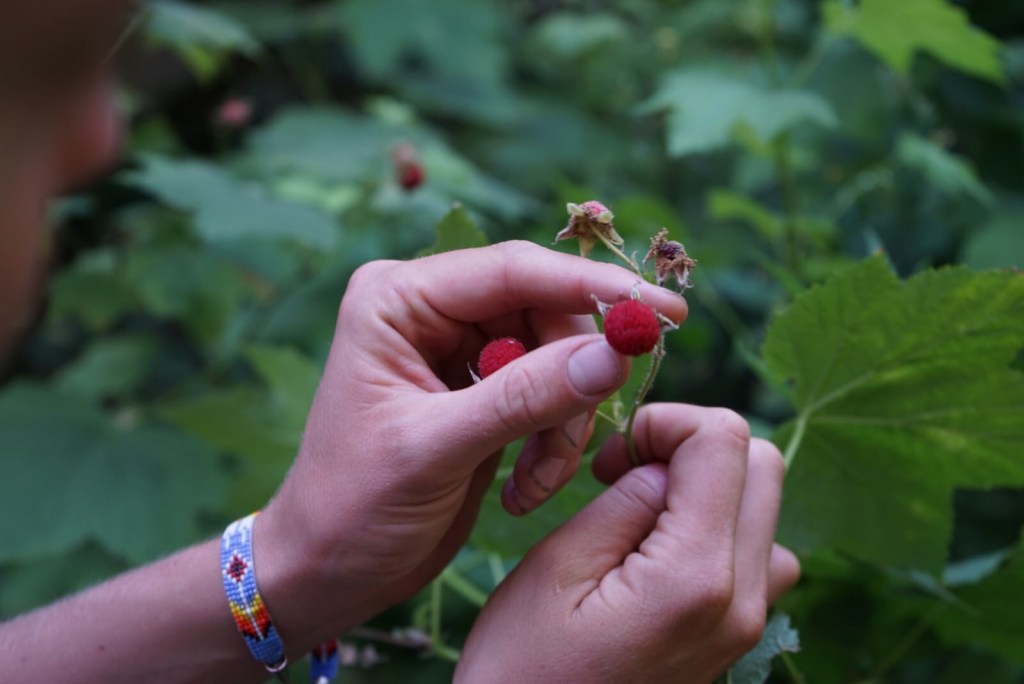
(Image by zrbuck)
I remember the first time someone told me to ask consent from plants to harvest their berries while foraging. At the time I was shocked, and I think I may have laughed a little. This isn’t unlike the responses I’ve gotten from parents when I suggest asking their kid(s) if they want to do something before telling them they will have to do it.
In my experience, I wasn’t seeing the plant as a living thing I needed to take cues from so I could interact with it in an informed way. Is it ripe and pink enough to eat? Are there enough other berries for the bears to be sustained by them? Will the bears be able to drop enough seeds to sustain the plant for next season?
People have needs that shape our interactions with them too and I believe we cannot reach true consent without acknowledging them.
So what is consent? It’s a popular word in culture at large right now, but also a new concept for some.
Consent is the agreement to do something or the permission for something to occur.
Some examples of consent in action are…
- Signing a waiver to enter a space (a gym, for example) saying you are responsible if some harm comes to you there
- Agreeing to allow people use your photograph from some experience you are doing
- Giving permission for your words to be quoted by other people
These questions are not usually asked of kids because the system is set up in a way where these permissions are given by a parent/guardian, not the kid themselves. School is not even a consensual choice, it (or a monitored version of opting out) is mandatory in many countries of the world.
Society simultaneously does not trust kids to be responsible for themselves (boo) and is afraid that parents would sue if something does happen to the kid. The message kids receive by these bypasses of consent (of which there are many more than listed above)is, “we do not really care what you think.”
How disempowering—what is left to do other than to get mad or cease any efforts to be involved? Also what a waste of an opportunity—things are really way easier, more creative, and more fun when kids are fully expressing their own preferences and permissions for themselves.
Recently in a flying squad, right after the whole group had slugged through some god awfully itchy grasses, one squadder who was new to the group mentioned loudly to no one in particular that they wanted to go home. I asked them if they would like me to contact their parent about it since I knew they did not have a phone themselves. They seemed surprised when I asked this but also very relieved—“yessss!” they sighed.
Before messaging the parent to ask if it was even possible, I read what I was writing aloud to the squadder to see if it was accurate for their experience of the situation. They said it was and thanked me. Later, while waiting to be picked up, I even gave my phone to them so they could talk to their parent and gave space for them to walk a ways off alone to take the call in private.
By the time the parent arrived for the early pick up, the squadder was at ease with the group, playing and enjoying themselves. The parent said they were not angry for having come, rather, they reflected to me that they learned the squadder needs to know that the option to leave is real. Once they knew they had the power to say if they wanted to be there or not, they eased into the group and felt empowered to do what they wanted.
Respecting young people, just like all people, starts with consent. It can be as simple as asking questions like, “what would you like to do/to do about it?” or, “how is this for you?” or, “are you okay with this right now?”
For folks who aren’t verbal processors, y’all may choose to use observation and nonverbal cues for consent together. These can vary person by person, but considering how consent can feel and look with each other can offer chances to learn about one another.
And consent isn’t a one time check in the box or pat on the back because it doesn’t stay the same forever, it can change moment by moment. Checking in with people on whether things are working or if they’re willing to try something different can really help embrace the adaptive nature of consent. I learned in a talk by Hope Wilder (author of Let’s Decide Together, the definitive guidebook for practicing sociocracy with children, out now!) two questions around consent that I like asking: “is it safe enough to try?” and, “is it good enough for now?”
Just be ready: once consent comes into the picture and questions of, “how is it going?” are opened up, the next step is to listen to the other person in order to understand how to reach consensus with them.
A NOTE ON CONSENT AND THIS BLOG: I will only ever use real names in a story on this blog when I have consent from the parties. I will note if I use fake names for the purposes of telling the story more simply than “kid #1.” Also, whenever possible, I’ll be asking the people involved in the story how they’d prefer to be referred to (i.e. kid, child, young person, squadder in the case of flying squads).
 Madi Learns
4 responses to “Real Talk on Consent”
Love it! The contextualization of consent in situations with young people is spot on.
LikeLiked by 1 person
Thanks, Zach 🙂 glad you dig it
LikeLike
Thank you for these thoughts Madi! I appreciated the concrete example : )
LikeLiked by 1 person
Thanks, Alison! Good to know re: concrete examples, I’ve been focusing on them since I saw your feedback on it here
LikeLike