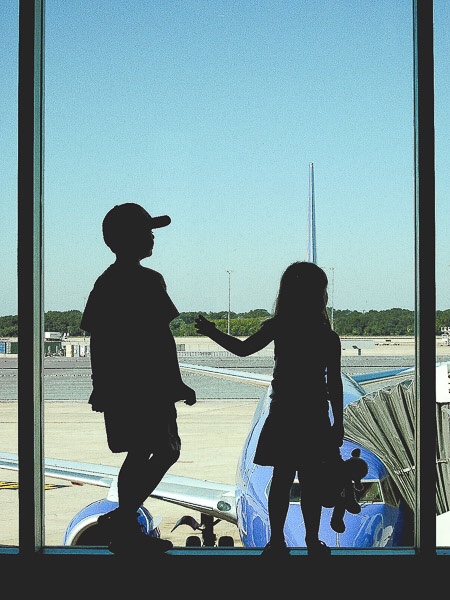
Featured image by Jillian Levenhagen
Yesterday in an airport, I watched a kid crying on the ground and the two adults next to them totally ignore them. I don’t pass judgement on anyone’s situation (really, I don’t, I swear…) but I use this example to acknowledge a common phenomenon in society at large: it is more common that kids are asked to listen to adults than they are listened to by adults.
Imagine… you’re a kid whose parents are always telling them what to do because they think they know what’s best for you. Or in school you spend all day having to sit and listen to adults tell you things or tell you how to do things and follow their orders. Or you’re at a store and you’re trying to buy something and someone tells you you can’t run around the store, you have to walk in a certain way.
That’s a LOT of instructions (and not even close to all of the most common ones received) on how to live to which kids are expected to listen and follow unquestioningly. So I have compassion when kids don’t want to listen. There are loads of times in self-directed learning centers when I acknowledge that a kid is not able to hear a reminder of some agreement.
Recently, in such a center, I tapped a kid on the shoulder to say, “our end of day clean up is starting! What do you want to clean up today?” Most of the time this kid is not super adverse to cleaning. However on this day, the kid ran around the space instead of responding to my question.
At first, I was frustrated. I wanted more harmony in the space with less chaos (would that you could have seen the stunning mandala of infinitesimal pearlier beads that was rolling its way across the floor) and more organization, but this kid was not willing to hlep! I took a moment to observe the kid and how they were running, and considered that maybe they needed to run and do their own thing in that moment, not clean. Perhaps, I thought, their need to run and be free is so strong that they’re not in a place to hear what I’m saying to them; perhaps this situation is them meeting those needs, not trying to sabotage mine.
I asked instead, “would you like to run and play outside for a bit before starting to clean?” The kid nodded and I followed-up by asking, “would you be willing to come inside and help clean after?” And they nodded again. When they did come back in, they hugged me before diving into the last minutes of clean up.
I learned later that this kid had been avoiding another kid in the space for most of the afternoon, trying to circumvent a tussle over something that had happened in the past and over which tensions were still high. Knowing this, the need to have some time to play alone made more sense to me—this kid hadn’t felt able to do so in the regular time for play. I was then able to offer my help to address the source of the difficulty and facilitate a conversation between the two kids.
Sometimes it is unrealistic to think people will be keen or even able to listen to others, especially folks who are receiving a lot of orders. It can also be unrealistic to expect people to listen to people whom they do not know or feel respected or trusted by. Consent can help, asking first, “can I ask for your help with something?” Or “are you free to help me with something right now?” But for me the goal is to build a relationship that is deeper than what two humans are doing for each other; it’s to build a relationship wherein both folks care about who the other human being is.
This kind of relationship can open up listening in different ways—what does the other person care about? What are their hopes and dreams? What are their fears and challenges? What about your relationship with them works or not? What an enriching connection for your inner life as well as theirs, and what potential for collaboration would grow between you. Who knows where it can go from there.
WANT TO PRACTICE LISTENING TO KIDS? One concrete way is to support efforts kids already have to put their voices into the world. I’m a long time fan of Brooklyn Apple Academy and their semi regular print and online newspaper, the Apple Gazette. The newspaper is almost entirely led by teen unschoolers (young people who self-direct their life decisions) and is probably one of my favorite media outlets ever. Give it a look here! If you’re able and interested, you can make a sustaining contribution or a one time donation to keep the website online and the paper circulating in print (they’re trying to raise $80/month).
 Madi Learns
2 responses to “On why listening can be hard (pt 1)”
Wow Madi! These kids are so lucky to have you!! Your ability to stay present with them is inspiring.
LikeLike
Thanks, Alison! Grateful to share the inspiration—I find things get so much easier when I interact in this way with kids and I hope it’s true for others who may try it!
LikeLike